Nanadie Project (100%)
(Copper-Gold)
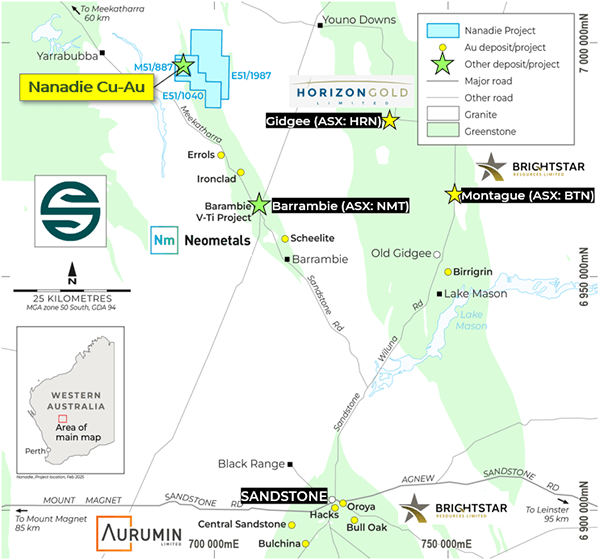
The Nanadie Copper-Gold Project
is located north-east of Sandstone in the Murchison District, Western
Australia. It comprises granted licences M51/887, E51/1040, E51/1987 and
L51/124 and exploration licence application E20/1097 covering a total of 137km2.
Nanadie represents a low cost,
high leverage copper opportunity underpinned by an existing JORC-compliant
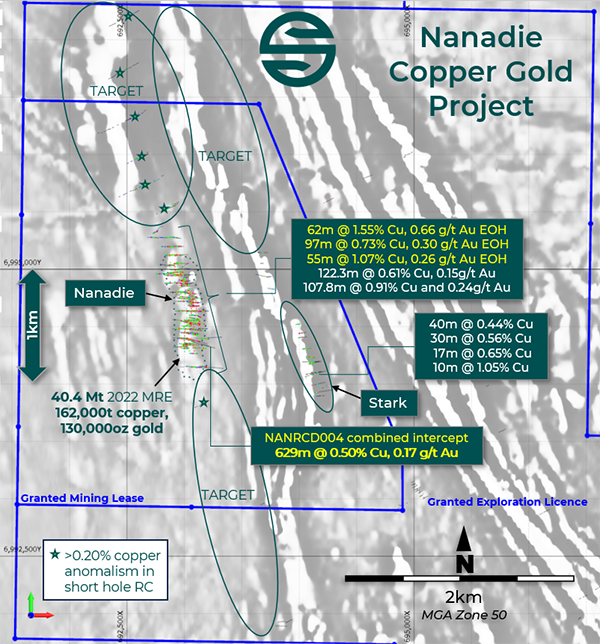
Inferred Mineral Resource Estimate (MRE) of 40.4Mt @ 0.4% copper and 0.1g/t
gold for 162kt of contained copper and 130koz gold. The deposit sits in a zone at
least 150m wide by 1km long, extends to surface and remains under-explored at
the margins, depth, and along strike – offering exceptional exploration upside.
The MRE sits within a granted
Mining Lease in a typical flat northern Goldfields setting, with shallow sand
and soil obscuring a geological package dominated by mafic intrusive,
amphibolite and granitoid intrusive rocks.
Solstice’s maiden Reverse Circulation (RC) delivered immediate success, with the first holes
returning impressive, best-yet drill intercepts that demonstrate the strength of the Nanadie mineralised system:
62m @ 1.55% Cu, 0.66g/t Au to end of hole (EOH) from 256m (NANRC004), including:
22m @ 2.78% Cu, 1.25g/t Au from 261m, and
97m @ 0.73% Cu, 0.30g/t Au to EOH from 203m (NANRC001).
Since
then, ongoing RC drilling has delivered wide zones of significant
copper mineralisation
in holes throughout the MRE area, including many holes drilled as
‘pre-collars’ for extending with future diamond ‘tails’ (i.e. the key
target zone remains further to the east/at depth). Importantly ongoing
drilling is intersecting widespread disseminated
and vein style chalcopyrite (copper sulphide) mineralisation,
demonstrating the width of the host gabbro and of the overall
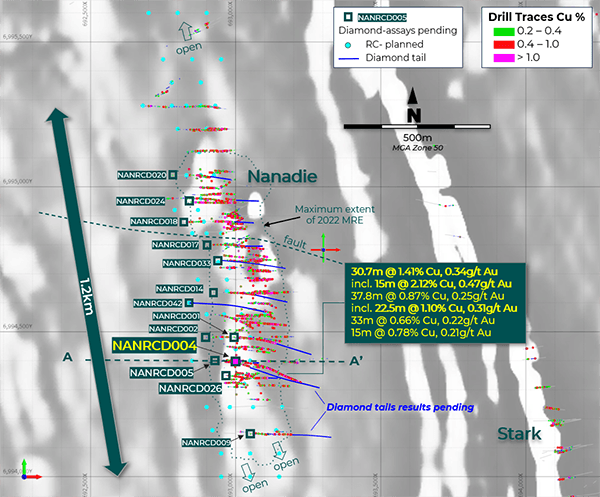
mineralised system. The deposit as currently defined is 100-200m wide,
at least 1.2km long, and remains open to the north, south and
at depth.
Broad
and continuous zones of high-grade mineralisation associated with
alteration and deformation
are taking shape in the eastern 100m of the host gabbro. This ‘eastern
margin’ corridor is emerging as a key exploration and MRE extension
target that will see a combination of shallow RC drilling and diamond
tails to increase drill density through the zone.
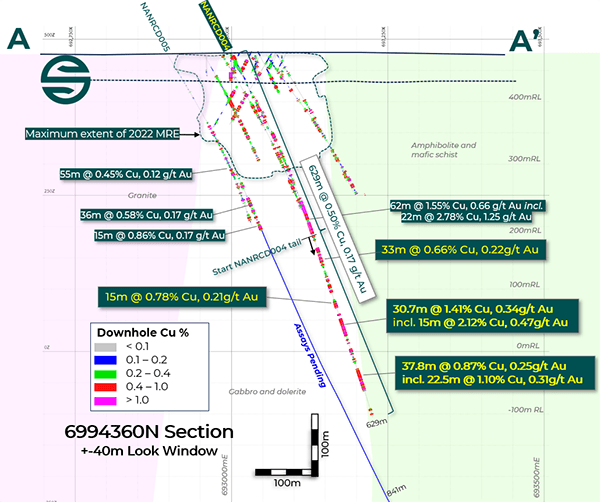
Recent assays from the Company’s first diamond ‘tail’ (extending a precollar RC hole), NANRCD004,
delivered an exceptional combined RC and diamond intercept of 629.1m @ 0.50% Cu, 0.17g/t Au from surface to end of hole (EOH) (including all unmineralised intervals), including 62m @ 1.55% Cu, 0.66g/t Au, 30.7m @ 1.41% Cu, 0.34g/t Au and 37.8m @ 0.87% Cu, 0.25g/t Au all within the eastern margin of the host gabbro. Visual observations
of significant disseminated and vein sulphide were also reported in
follow-up
tail NANRCD0053, which intersected strong zones of mineralisation from
the base of the pre-collar to its final depth of 840m.
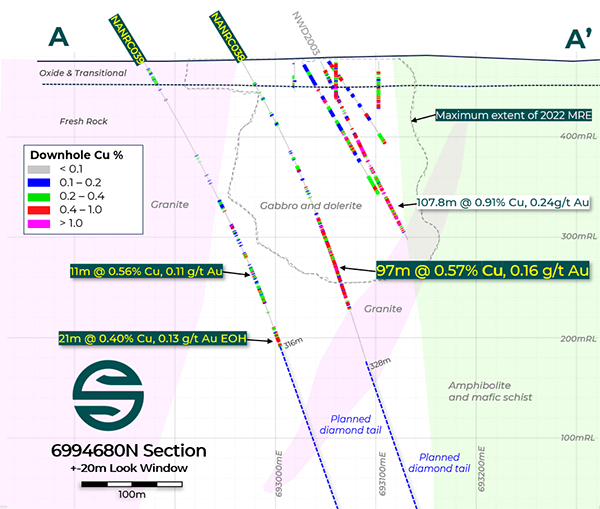
Solstice’s
ongoing RC and diamond campaign comprises step-out strike traverses,
MRE delineation
holes, and step-down exploration holes generally testing the deposit
between surface and approximately 500m below the existing MRE. Observed
geology in both RC and diamond drilling continues to be broadly
consistent with that seen in Solstice’s drilling reported
to date and is building the Company’s geological understanding of this
substantial and growing mineralised system.
Our
work to date has shown clear potential to expand an already significant
deposit into
a standout large-volume copper-gold system in WA’s premier Goldfields
mining jurisdiction. With $45 million cash (at June 30 2026) and no
debt, Solstice is well positioned to continue growing Nanadie through
drilling, IP and downhole EM geophysical techniques,
and applying an updated geological model that has opened targets at the
nearby Stark Prospect and exploration corridors extending north from
Nanadie and Stark beneath shallow transported cover.
Nanadie Geology
Phase 1 RC drilling, as well as systematic
re-logging of historical drill holes has resulted in increased understanding of
the copper-gold mineralisation and has built a geological picture comprising a
widely mineralised steeply dipping host mafic intrusive (gabbro and dolerite)
package flanked by amphibolite (that is also mineralised in places), and
younger granitoid rocks to the west.
Historical drilling below a
shallow soil and sand cover and ~30m partial weathering profile has defined a
wide, near-surface accumulation of disseminated and remobilised sulphide
veinlet style chalcopyrite (+/- pyrrhotite and pyrite) mineralisation. Approximately
90% of the MRE is fresh rock mineralisation below 40m depth.
Significant zones of >1% Cu
occur where chalcopyrite vein density increases, and increased sulphide veining
is typically accompanied by raised gold values. The fine disseminated and vein sulphide
mineralisation is a style that lends itself to simple float extraction. No
deleterious elements have been noted in available multi-element data, and
Solstice expects that planned sighter metallurgical test work will demonstrate
a commercial concentrate could be produced.
An
updated geological model suggests both deposits have a broad
accumulation of disseminated
copper-gold mineralisation in an intrusive setting, followed by
remobilisation during a deformation, felsic intrusion and alteration
event likely responsible for the wide zones of high-grade mineralisation
encountered to date. The revised model has significantly
expanded the Company’s exploration footprint and identified multiple
new opportunities for both strike extensions and structural repetitions,
including at Stark and in sparsely explored soil-covered areas to the
north and south of existing drilling.
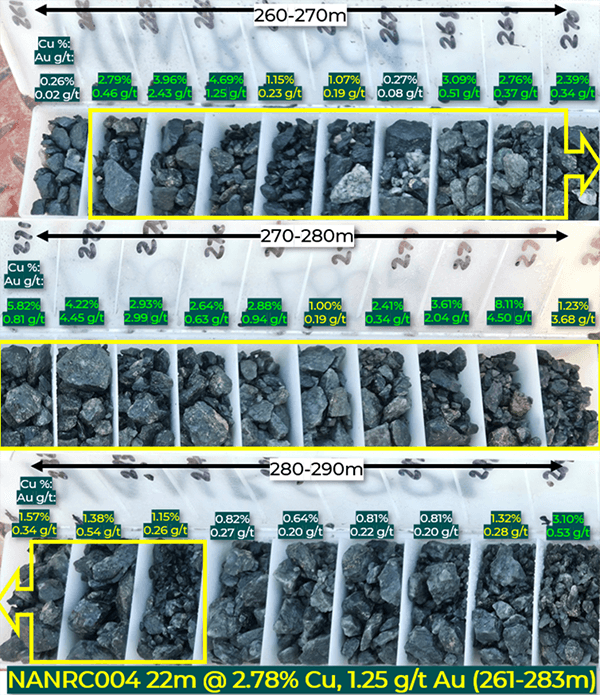
Nanadie Project drill chips from drill hole NANRC004 showing strong Cu and Au mineralisation.